
Growing Mediums
Today’s grower has a multitude of growing mediums in which to choose from, allowing them to pick and choose a medium that is most suitable to their growing needs. Choosing a growing medium that is appropriate for both the type of plant being grown and also the type of system being used for cultivation will help the grower achieve success in the garden.
The following is a list of some of the more popular growing mediums used by both novice and professional growers.
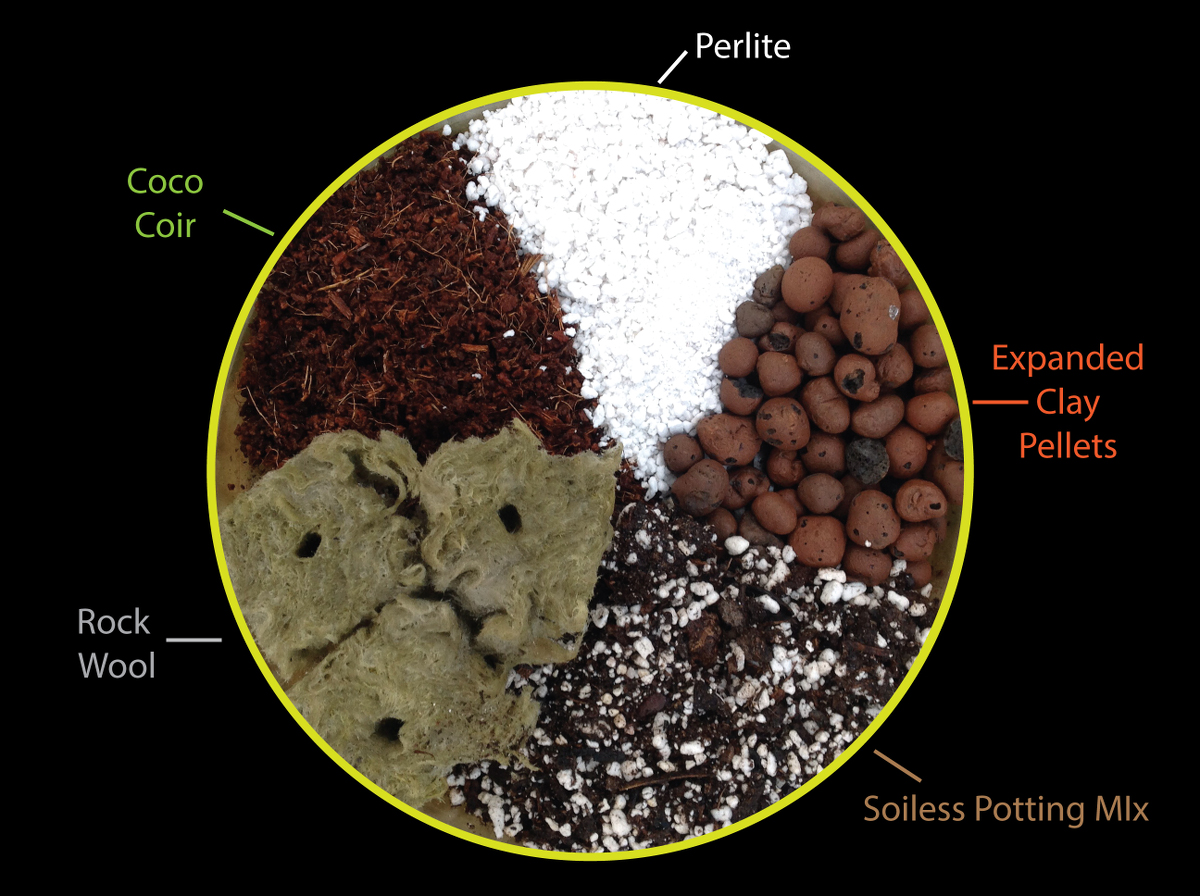
Sphagnum Peat Moss – Pro- Works great with water retention. Can be used in soil based and soilless growing. Con- acidic in nature. It may need a pH buffer like perlite. An environmental concern for using peat moss is that the bogs from which they are harvested are ecologically fragile. There is a movement to protect these nonrenewable habitats. If you are fond of wild orchids, carnivorous plants, and whooping cranes, Peat moss might not be your jam.
Coco-Coir (Coconut Chunks of Fibers)- Pro- Coir is also great for water retention as well as aeration. Let those babies breathe. It’s pH hovers around a 6-6.5 which is pretty good for plants. It’s a renewable and organic source- yay! We recommend the unsterilized version of coco coir because it still contains our friendly fungi, the Trichoderma, which have a symbiotic relationship with roots. Good stuff right there. A con would be that it holds on to moisture so you may want to mix it with some perlite. Also, because of its source (near saltwater), it is high in (you guessed it) salt content. Your future plants told us to tell you to soak your coir at least once before using it.
Rockwool – results from melting basaltic rock, spinning it into fibers, and manufacturing it into slabs. It is one of the more popular of substrates. It is best to get a horticultural grade Rockwool because mineral wetting agents are usually included in the manufacturing process. This is good since untreated Rockwool is naturally hydrophobic. Rockwool usually has a high pH so it needs to be soaked first. The runoff water after the soak should be at a 5.5 .
Perlite – has some major advantages. It is lightweight, stable, reusable, inexpensive, and can retain water very well. Perlite floats so it should be mixed with something or it will float away on you. It is more alkaline at a 7-7.5 pH so it can’t be used for more acidophilic plants like rhododendrons and azaleas.
Expanded Clay Pellets – are lightweight, inert, and have much to offer in terms of aeration. Clay pellets are high in surface area which make suitable conditions for microbial growth. They are reusable after a simple sterilization. However, it is not the best option in terms of your carbon footprint. They are mined by making huge holes in mountainsides and sources are depleting. Instead, try Growstones® which are totally sustainable and made from recycled glass! Check out Growstones® here! http://www.growstone.com/
Organic Soil-Less Potting Mix – When choosing the right soil-less mix, there are a few things to consider. The general rule of thumb is to have a light and fluffy mix. You want to make sure you have proper aeration and water holding capabilities. You want to have and maintain the right pH so the nutrients remain available. When pH is too low or too high, nutrients become toxic to the plant and results in plant death. As we always say here at Age Old™, know your plant and what it needs. The first step is a good soil or potting mix. Happy Growing!